Repurposing frameworks do not fail because the ideas run out. They fail because the shape you picked was sized for a smaller week than the one you are having.
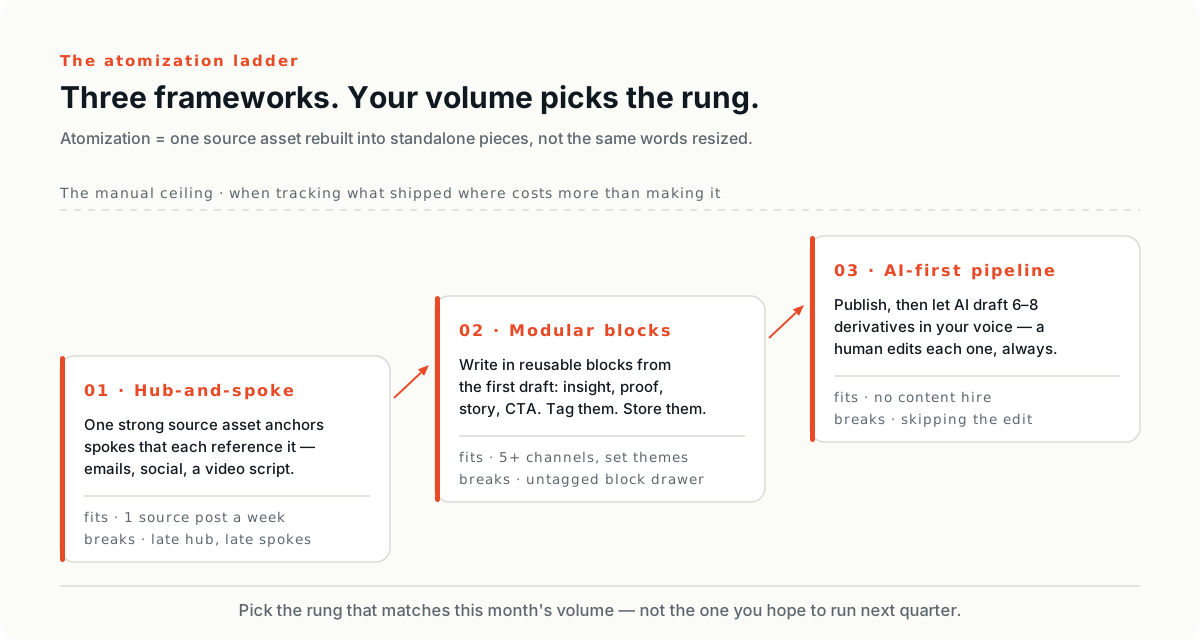
There are three shapes worth running: hub and spoke, modular blocks, and an AI-first derivative pipeline. Most advice presents one of them as the method. It is not the method. It is the one that happened to fit the volume its author was publishing at.
This guide names all three, says what each costs to run, and marks the point where each stops holding. Three shapes. Three different ceilings.
Atomization is not reformatting
Content atomization means pulling standalone assets out of one source piece — the argument, the number, the story — and rebuilding each as its own native thing. Reformatting means taking the same words and making them fit a smaller box. On the page the two can look similar. The output is not the same.
A reformat depends on its source. Read it without the original behind it and it reads like a trailer for something you have not seen. An atomized derivative stands on its own, because it was rebuilt around one idea instead of compressed around all of them.
Why framework advice stops working at volume
At low volume almost any framework works. You publish one strong piece, spend an afternoon cutting it into five updates and two emails, and it feels like a system because you are comparing it to doing nothing.
Raise the volume and that same manual process comes apart. The constraint is not creativity. It is the number of small choices the process asks one person to make — which passage, which format, which channel, which week — because that count rises with volume and the person does not.
Nothing failed. The shape was sized for a smaller week. That is a different problem from a broken framework, and it takes a different fix: change the shape, not the effort.
Framework one: hub and spoke
One substantial asset anchors the cycle and everything else derives from it. A long post becomes an email sequence, three social posts and a short video script, each written for its own format but pulling from the same core argument.
It is the easiest of the three to start and the easiest to check, because there is exactly one thing to verify for accuracy and everything downstream inherits from it. It needs no tooling you do not already have.
The ceiling is structural, not effort-related. The hub is a single point of failure. If the source slips a week, every derivative slips with it, and nobody downstream can start early because there is nothing yet to derive from. That is harmless at one source per cycle. It is unworkable the moment two people are waiting on the same author.
Framework two: modular blocks
Instead of finishing a piece and carving derivatives out of it afterward, you write in units that were built to travel. A block is self-contained: it makes sense with nothing around it, so it drops into a post, an email, a deck or an ad without a rewrite.
Four kinds cover most of what a service business actually produces:
- ›Insight blocks — one idea in two or three sentences, portable to any platform
- ›Proof blocks — a number or a result with its source attached, so the citation travels with the claim
- ›Story blocks — a short example, roughly a hundred words, that works alone or as a section inside something longer
- ›Call-to-action blocks — one action sentence, written per channel rather than pasted across them
The inversion is the whole point. Hub and spoke deconstructs after the fact; blocks are built for reuse in the first draft. That changes what writing feels like, and it is what lets one draft serve a blog, an email and two or three social channels without a separate rewrite for each.
The ceiling here is not volume. It is librarianship. Blocks only pay off if they are labeled and still findable months later, which means somebody owns the labeling. Without that owner you do not get a library. You get a drawer of fragments nobody can search, and the framework costs more than it saves.
Framework three: the AI-first derivative pipeline
The third shape keeps the human at both ends and hands the mechanical middle to a model. You produce the source, hand the model a tightly constrained slice of it, take six to eight derivative drafts back, and edit every one for fact before anything ships. The model is the first-draft machine. It is not the author.
The step-by-step version of that pipeline is the workflow in our repurposing pillar, and it is worth reading before you commit to this shape rather than after. Two of its findings decide whether the shape works for you. Constrained input beats a full transcript, so what you hand the model matters more than which model it is. And editing for fact is a fixed cost of publishing that does not shrink as your prompting improves.
That second one sets the ceiling. Generating drafts costs minutes; checking them costs judgment, and judgment does not batch. The pipeline scales until the person doing the checking saturates, and then it stops. Doubling the drafts does not double the output. It doubles the queue.
How to pick: match the shape to the constraint
Pick against the volume you are publishing this month, not the one on the plan. These are not ranked. Each is correct inside its own range and wrong outside it.
- 01One substantial source a week, one person managing it: hub and spoke. Lowest overhead, nothing to buy, and the single point of failure does not bite yet.
- 02Five or more channels with recurring themes: modular blocks — but only if you can name the person who files them.
- 03No dedicated content person and an owner wearing the marketing hat: the AI-first pipeline, with the fact edit treated as part of the work rather than a nice-to-have.
Two of the three compose. Blocks and an AI pipeline fit together cleanly, because a stored proof block is exactly the kind of constrained input a model handles well. Hub and spoke composes with neither. It is the shape you outgrow, not the shape you layer.
Where every framework stops and software starts
All three share one ceiling that has nothing to do with writing. Past a certain number of live derivatives, the record of what was made, from what, for which channel, and whether it actually went out becomes its own job. The tracking spreadsheet stops being a convenience and starts being a part-time role.
This is a bookkeeping problem, not a discipline problem. Live derivatives multiply by channel, each with its own specs and cadence, and the record of them grows every cycle while the person keeping it stays the same person doing the work. Something gets dropped. Usually the thing nobody was waiting on, which is also the thing that was compounding.
Software removes the tracking burden. It does not remove the choice of shape, and buying a platform before you have picked one only gives you a faster way to run the wrong one. Pick the shape first. Buy the tracking second.
The signal that says switch
There is a clean trigger for moving off a manual process, and it involves no headcount number and no revenue band. Time how long you spend recording what was repurposed, and time how long you spend repurposing. When the first number passes the second, the manual process has hit its ceiling. Everything before that is a preference. This is a measurement.
It is the same failure pattern operators already recognize from missed calls and stale estimates. The process works fine until volume rises, then it leaks quietly, and nobody notices until the quarter closes.
Next: the five-stage workflow all three shapes run on
Related: how to compare the tools that generate the derivatives