One post, three destinations: a feed, an inbox, a camera. The claim that travels is the same in all three; almost nothing else about them is, and a draft that ignores the difference reads like a summary three times over. Choosing which sentence travels is a separate job, and a published post gives it up less easily than a recording does.
The five-stage workflow this sits inside
Start after the claim is chosen
Every derivative inherits the claim, not the outline, and deciding which sentence carries it is a by-hand pass that happens before any tool is open. That pass has its own article next door. This one picks up at the moment the sentence exists.
How to find the claims in a post that survive on their own
Three destinations, three readers
The same claim goes three places. What changes between them is not length, and it is not tone in the way style guides mean it. It is what the reader already agreed to at the moment your words show up.
The caption — the reader did not ask for this
Write as though only the first line will be read. The assumption costs nothing if it turns out to be wrong and saves the caption if it is right. State one idea, then stop.
A caption that summarizes the post is competing with the post. A caption that makes the claim and leaves the argument unmade is doing the job the post cannot do from inside a feed — being interesting to somebody who was not looking for it.
The email — the reader already said yes
A subscriber already said yes once, so the body is not fighting for attention the way a caption is. The subject line still is. A draft that comes back describing the contents has produced a table of contents, not a subject line — describing closes the idea, and a subject line has to leave one open.
The body edit is not compression. Shrinking every paragraph by the same proportion preserves the shape of the post and loses the point of it, and proportional shrinking is exactly what an instruction to make it shorter asks for. Cut two thirds outright instead, keep the section carrying the claim, and let it run longer than it ran on the blog.
Email is also the destination that hands the reader a reply button pointed straight at you, which is what turns a question into a real call to action rather than a rhetorical one. An answer arriving in your inbox is worth more than a click you cannot ask a follow-up question about.
The video script — the reader is not reading
Written prose is built for the eye. It tolerates subordinate clauses, parentheses, the occasional semicolon. Spoken language punishes all three. The source post is full of them and nothing in it marks them as a problem, so a format conversion carries them straight across — a blog post with line breaks in it.
The fix is not a longer prompt. Read the draft out loud. Where you run out of breath, the sentence is too long; where you stumble, the word order is wrong. It is the one editing pass that cannot be done silently, which is what makes it the easiest one to skip.
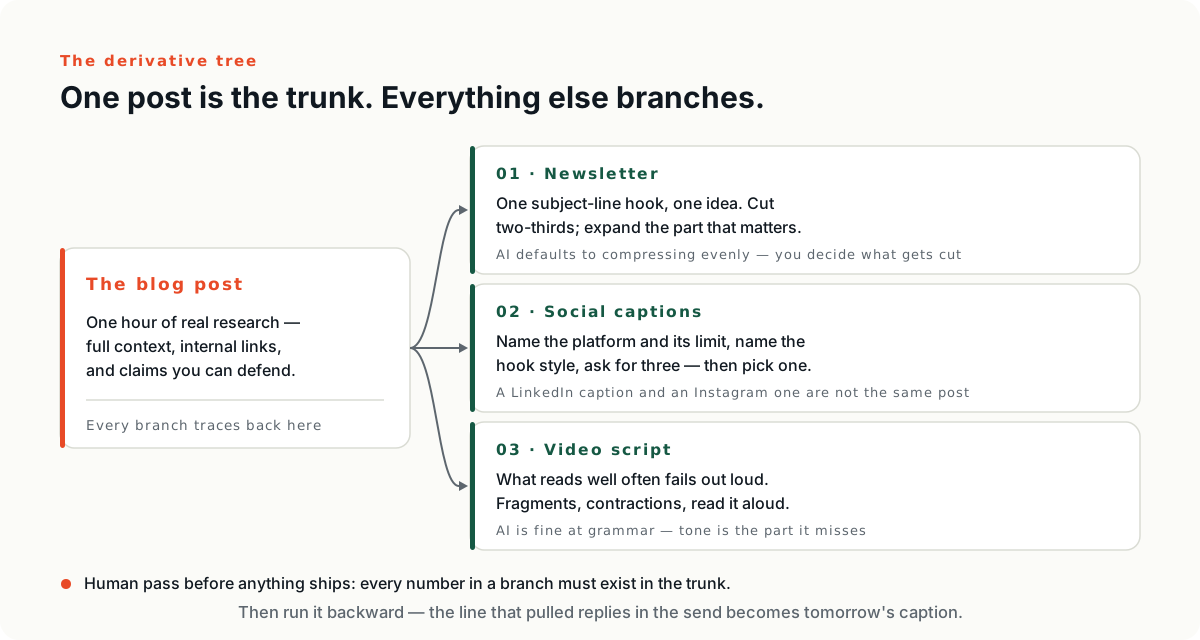
What the model is actually doing
In all three handoffs the model is doing format conversion, not thinking. Give it a claim you have already isolated plus an instruction describing the destination, and it is genuinely good at writing that claim in the shape you asked for. Ask it to decide which claim matters and you have handed over the one judgment the post was written to make, with nothing to check the answer against.
- ›Hand it — the claim as one sentence, the two or three passages that support it, and one destination with its constraints named.
- ›Do not hand it — the whole post with a request for ten outputs. That input is what produces ten flat ones.
- ›Never accept from it — a number, a name, a price or a customer detail that was not already in the post.
We name no products and no prices here, on purpose. Tiers move, feature names change between the day a page is written and the day it is read, and a wrong fact about somebody else's product is a defect with your name on it. What is worth knowing before you buy is what a product meters — seats, credits, tracked prompts, flat account fees — and that comparison already exists next door.
What the generation tools actually meter
The reverse pass: email back to caption
Run the whole thing backwards once the email has gone out. A published post rarely tells you which sentence landed. A send does: one line gets replies, one line gets forwarded, one line gets quoted back to you at a job site.
Build the caption around that sentence instead of returning to the post. You are no longer guessing which idea travels, because somebody told you. It is the step that gets easier the longer you run it, since every send leaves you better informed than the one before.
- ›Give the sentence the send picked for you the same standalone check the extraction pass uses.
- ›Does it contain a number that was fine unsourced in an inbox and is not fine in public?
- ›Does it still sound like you when it is read cold, without the greeting that set the tone?
Where this breaks
- ›The post has no claim. Three formats will not manufacture one, and each will make its absence more visible.
- ›All three ship the same week. The spacing rule from the workflow applies here too — three renderings of one claim inside the same few days reads as repetition rather than a point of view.
- ›You judge the caption by clicks to the post. That was the one job it was not doing.
- ›Nobody owns the claim sentence. If choosing it belongs to whoever has time, it belongs to nobody, and you are back to generating.
Next: what the scheduling tools are actually charging for