Ask an AI to summarize your blog post for social and you get a shorter blog post. That is not a prompting failure. A published article is a finished argument, and its best sentences are load-bearing — they are true because of the sentence before them. Repurposing a long-form article is not compression. It is finding the few claims that stay true alone, then rebuilding each one for the place it will be read.
A published article is not raw material
A recording and a published article are not the same kind of source, and the difference decides the work. A recording is long, unstructured, and mostly filler, so the job is finding the good minute. A published article is the opposite. It is already structured and already ordered, every paragraph placed to set up the next one. Nothing needs finding. That is the problem.
That sounds like an advantage, and partly it is: the fact-checking cost was paid the day you published. But the structure that makes an article good is exactly what makes it hard to break apart. Paragraph four earns its claim from paragraph three. Pull it out and it becomes an assertion with no support — which is precisely what a generic AI caption is.
The repurposing pillar sets out a five-stage workflow and a matrix whose rows are all raw sources: a recorded job walkthrough, a customer conversation, a teardown, a measured number, a question you answered this week. A published article is none of those. It is a source the matrix has no row for, because it is not raw — it is already a finished derivative of something else. That is why it needs its own pass. And this pass has one destination, the social feed, where a post carries a single detached unit instead of inheriting the article's whole argument. Hold that fence, because everything below is built on it: the inventory you are about to make is an inventory for a feed. The same unit headed for an inbox is a different job, and a different article.
Detachability is the test, not quality
The instinct is to hunt for the best line in the article. Wrong test. The best line is usually the one that depends most on everything around it.
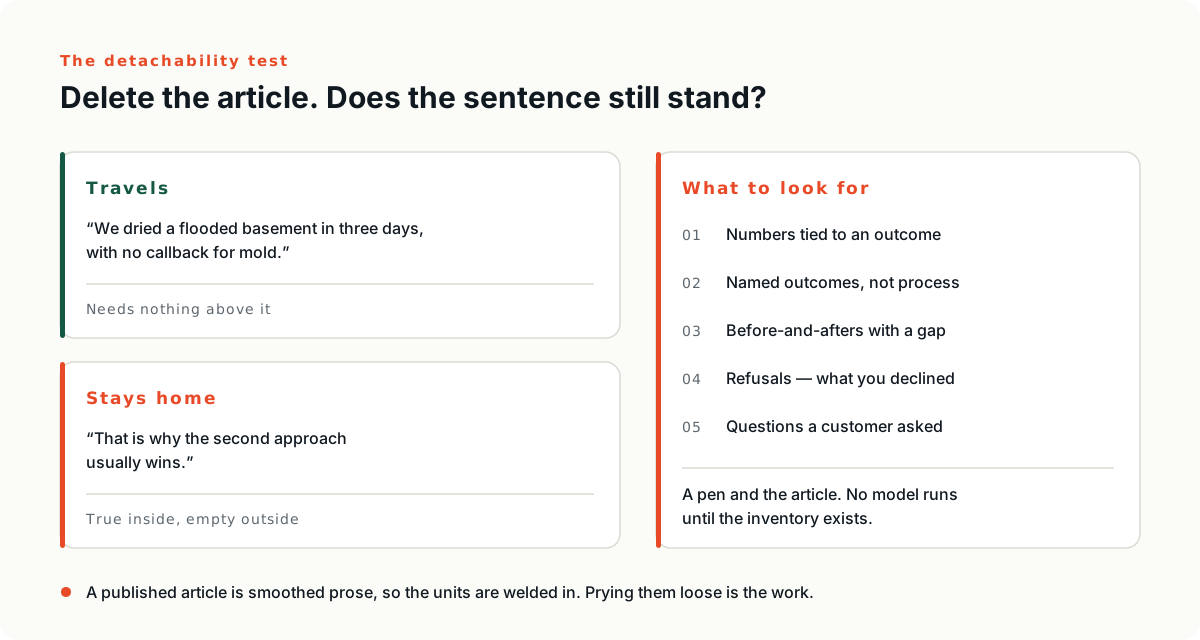
The test is detachability. Read a sentence out loud with nothing before it and nothing after it. If a stranger scrolling past would understand it and believe it, it is liftable. If it needs the setup, it is not — and the setup is the thing you are trying to leave behind.
- ›Detachable: “We dried a flooded basement in three days with no callback for mold.” Nothing before it is required.
- ›Not detachable: “That is why the second approach usually wins.” True inside the article, empty inside a feed.
- ›Detachable: “A furnace that short-cycles is usually a filter problem, not a furnace problem.” A complete claim that argues with what the reader already assumes.
- ›Not detachable: “The third option is the one we recommend for most accounts.” Which third option? The list that counted them is gone.
Do the detachability pass before you open a model
Twenty minutes with the article and a pen, before any tool is involved. The pillar budgets ten minutes to mark a transcript; an article costs more precisely because it was edited. In a recording the useful passage sticks out from the filler around it. In an article nothing sticks out, because it was edited so that nothing would — so you test sentences one at a time instead of spotting them. You are not writing yet. You are counting.
- 01Numbers. Any figure attached to a named outcome — days, dollars, a count, a percentage you actually measured. A number with no outcome attached is a statistic, and a statistic is not a post.
- 02Named outcomes. What changed for someone, stated as a result rather than a process. “Zero callbacks for mold” is an outcome. “We used commercial dehumidifiers” is a process.
- 03Before-and-afters. Two states with a gap between them. These need the least text, because the reader does the arithmetic themselves.
- 04Refusals. Anywhere the article says the common approach is wrong, or that you declined to do something. A refusal encodes a decision somebody actually made, which is what makes it specific enough to travel.
- 05Questions you answered. A question a customer really asked, plus your answer in one sentence. An article written out of customer questions is dense with these, and they are easy to skip past because they do not look like highlights.
Number them in the margin. The count you end up with is the number of posts that article can carry. Not the number a tool promises. Not the number your calendar wants. The number you just made by hand.
Summarize is the wrong verb
Now the prompting, and the whole thing turns on one word.
Summarize this post for social media asks the model to compress. Compression preserves the proportions of the original, which is precisely what you do not want — you want one unit at full size and everything else gone. What comes back is a smaller version of the same argument, in the same register, reading exactly like what it is.
Hand the model the unit you already found and a format to put it in. This is the pillar's constrained-input rule applied to a source that does not supply the constraint for free: on a transcript the marked passage is obviously narrower than the recording, while on an article you have to cut the constraint out yourself. Either way the model is no longer deciding what matters. That decision was yours, made with a pen, twenty minutes ago.
- ›Name the unit, then the format. Hand it unit three from your inventory and ask for a three-slide carousel, not a summary of the article that contains unit three.
- ›Constrain the length before it starts, not after. Under a hundred words is a different draft than three hundred words trimmed.
- ›Forbid the setup explicitly. Say no background, no narrative, no company history. Otherwise the model rebuilds the paragraph you deliberately removed.
- ›Ask for the claim first. If the outcome is not in the opening line, the post is a story, and the scroll already ended.
- ›Ask for three variants of one unit rather than one variant of three units. The second is a summary wearing a costume.
The case study is built from these units, and carries a permission problem
A case study is built out of exactly the units you are hunting: a number, an outcome, a before-and-after. It is also the one where lifting badly can cost you the customer.
Start with what gets cut. The narrative — the intake call, the assessment, the equipment list, the final walkthrough — is the part that made the case study readable and the part that has to go. Three things survive: the number, the problem, and the fix.
A nine-hundred-word water damage write-up becomes one line: flooded basement, mold risk inside forty-eight hours, full dry-out in three days, no callback. A before-and-after photo underneath it. That is the entire post, and it reaches the channel the article itself was never going to reach.
Format follows the platform, not preference
One unit can go out in more than one shape, and the shape is decided by how the platform gets read, not by which one you enjoy building.
- ›A carousel when the unit has steps — an assessment, an intervention, a result. People swipe because each panel owes them the next one.
- ›A single image with a caption when the unit is one number and you have a photograph that proves it. Nothing else should compete with the number.
- ›A plain text post when the audience reads rather than scrolls — property managers, commercial buyers, anyone evaluating you rather than discovering you.
- ›A short video script when the unit is a process the camera can show faster than a sentence can describe it.
Same unit, four shapes, four posts. This is where the count from your inventory multiplies — but only after the unit passed the detachability test. Four shapes of a claim that needed its paragraph is four bad posts.
What one article is actually worth
The honest ceiling: the number of posts an article can carry is set by the units inside it, and an article usually holds fewer than its word count suggests.
A well-built case study with a number, an outcome and a before-and-after supports several. A thousand-word explainer that never commits to a specific claim supports one, maybe none. That is not a tooling problem. There is nothing in the article for a tool to find, and no extraction step can produce a claim the source never made.
Which makes this a writing instruction as much as a distribution one. If you know an article will be repurposed, put a detachable claim in it on purpose. It costs nothing while you are drafting and it is expensive to add later.
Next: six social tools, six billing meters — what publishing this actually costs
Related: the full repurposing workflow, from source asset to scheduled derivative
Also: when the same claim has to go to an inbox and a camera, not just a feed