Strategy
Revenue Optimization for Service Businesses: The Four-Lever Method
Revenue optimization in a service business comes down to four levers — acquisition, retention, pricing, recapture. Score each, fix the biggest leak first.
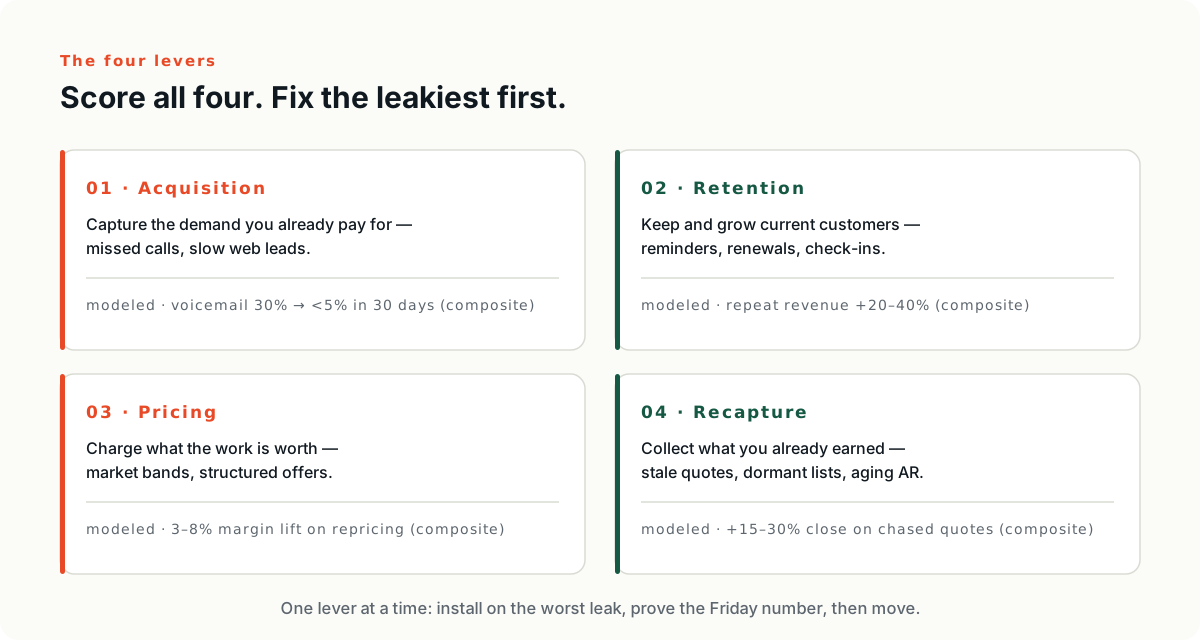
Revenue optimization for a service business isn't a new marketing channel — it's working four levers on the revenue you already generate: acquisition (capture the demand you're paying for), retention (keep and grow current customers), pricing (charge what the work is worth), and recapture (collect what you've already earned). Score all four, fix the leakiest first.
Lever one: acquisition — stop leaking demand you paid for
Before buying more leads, capture the ones already ringing your phone. After 5pm, 30–60% of inbound calls typically hit voicemail, and the first vendor to answer a web lead wins roughly 78% of the time. The acquisition loops — missed-call recovery, speed-to-lead — are about converting existing demand, which is why they're usually the first install.
The missed-call recovery playbook
Lever two: retention — the cheapest revenue is repeat revenue
It costs far less to keep and expand a current customer than to win a new one. The retention loops run the unglamorous work that makes that true: service reminders that actually go out, seasonal check-ins, membership renewals.
Lever three: pricing — the lever most operators never touch
Most service businesses set prices years ago, under different costs, and haven't looked since. The pricing loops read local and regional pricing bands, flag services priced below market, and test structured offers. Small changes add up on every job you already do.
Lever four: recapture — collect what you already earned
The fastest optimization is money that's already yours: quotes that went quiet, customers who went dormant, invoices aging past 60 days. Chasing stale quotes, reactivating a dormant list and working aging invoices all go after revenue you've already earned, so start by measuring how much is sitting in each.
4
levers: acquisition, retention, pricing, recapture — scored separately, fixed in leak order
“Pricing is the lever nobody pulls because it's scary. Recapture is the one nobody pulls because it's boring. Both beat buying more leads, and neither requires a single new customer.”
How to know which lever leaks most
You score it with data you already have: phone logs (acquisition), repeat rate and churn (retention), price list age and win rates (pricing), stale-quote count and AR aging (recapture). Each lever's leak gets a dollar size; the biggest one names your first install. The visibility to keep score week over week comes with the loop:
Real-time revenue visibility: one Friday number per loop
And before committing to any install, run the payback math against your own numbers:
Frequently asked questions
—What is revenue optimization for a service business?
Systematically working four levers on revenue you already generate: acquisition (capture existing demand), retention (keep and grow current customers), pricing (charge market rates), and recapture (collect stale quotes, dormant customers, and aging AR).
—Which revenue lever should I optimize first?
The one leaking the most dollars — measured, not guessed. Score all four with data you already have (phone logs, churn, price-list age, AR aging) and install one loop on the worst leak before touching the next.
—How does AI help with pricing optimization?
The pricing loops read local and regional pricing bands, flag underpriced services, and test structured Good/Better/Best offers.
—What results can I expect from revenue optimization?
It depends on your own numbers. Measure your stale quotes, dormant list and overdue invoices first, then set the payback window you'll hold each loop to.